How Custom Thermal Labels Support Modern Business Operations Today
Smarter labeling solutions improve accuracy, speed, tracking, and everyday efficiency

Introduction
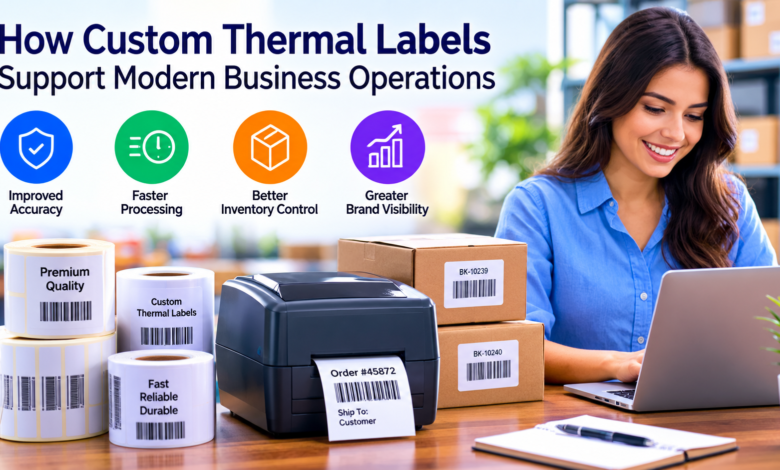
Modern businesses depend on accurate information to keep products, orders, inventory, and shipments moving smoothly. From warehouses and retail stores to manufacturing facilities and e-commerce operations, labels play an important role in connecting physical products with digital business systems. How Custom Thermal Labels Support Modern Business Operations is therefore an important topic for companies looking to improve identification, organization, and workflow efficiency.
Custom thermal labels can be produced in different sizes, materials, formats, and specifications to meet particular operational requirements. They can also carry changing information such as barcodes, product numbers, prices, dates, batch information, and tracking details. Thermal printing is widely used for shipping, inventory, retail, manufacturing, healthcare, and other applications where fast and consistent labeling is important.
Quick Overview
| Feature | Business Benefit |
|---|---|
| Custom sizes | Fits different products and packages |
| Barcodes | Supports fast identification and scanning |
| Variable data | Allows changing information to be printed on demand |
| Different materials | Matches indoor, outdoor, cold, or demanding environments |
| On-demand printing | Reduces dependence on large quantities of pre-printed labels |
| Thermal technology | Supports fast and consistent label production |
What Are Custom Thermal Labels?
Custom thermal labels are labels designed for specific business requirements and printed using thermal printing technology. Instead of relying on conventional inkjet or laser printing, thermal systems use heat to create text, graphics, and machine-readable codes.
There are two major approaches: direct thermal and thermal transfer. Direct thermal printing uses heat-sensitive label material and does not require ink, toner, or a ribbon. Thermal transfer printing uses a heated ribbon to transfer an image onto the label material and is generally better suited to applications where longer-lasting print durability is required.
The right choice depends on how long the label needs to remain readable and the conditions it will experience.
Why Businesses Need Flexible Labeling
Not every product or package has the same labeling requirements. A small retail item may need a compact price and barcode label, while a warehouse carton may require a larger label containing shipment information and multiple identifiers.
Custom labeling gives businesses greater control over dimensions, materials, adhesive characteristics, and printed information. This flexibility can be especially useful when companies handle different products, packaging styles, storage environments, or distribution channels.
Instead of forcing every application into one standard format, businesses can develop labels around their actual operational needs.
Improving Inventory Management
Inventory accuracy is essential for modern businesses. Employees need to know what products are available, where they are stored, and when they move between locations.
Custom thermal labels can identify individual products, cartons, shelves, bins, pallets, and storage areas. When combined with barcodes, these labels can connect physical inventory with information stored in inventory-management software.
GS1 explains that barcodes can encode identifiers and additional information such as product, shipment, location, serial number, batch, and date information. This makes barcode-based labeling an important part of supply-chain identification and tracking.
Better identification can help employees scan products quickly instead of relying entirely on manual data entry.
Supporting Warehousing and Logistics
Warehouses handle large quantities of products every day. Clear labeling helps workers identify goods, organize storage areas, prepare orders, and move packages through different stages of fulfillment.
Thermal labels are commonly used for shipping and logistics because information can be printed when it is required. A business can generate a label containing the correct order number, barcode, destination information, or tracking details without maintaining separate pre-printed labels for every possible shipment.
This on-demand approach can be particularly valuable for businesses with changing orders and high shipping volumes.
Helping E-Commerce Fulfillment
E-commerce businesses often process orders continuously. Every package may contain different customer, product, and shipping information.
Custom thermal labels can support this workflow by allowing labels to be generated according to individual orders. Shipping labels, product identification labels, inventory labels, and internal fulfillment labels can all be incorporated into the operational process.
Fast label production can help employees move from picking to packing and shipping without unnecessary delays. Thermal printing is also commonly used in courier and parcel applications where reliable barcode scanning is important.
Supporting Retail Operations
Retailers use labels for more than prices. Labels can support product identification, inventory control, shelf management, promotions, and barcode scanning.
As retail systems become more data-driven, machine-readable identification becomes increasingly important. GS1 notes that both traditional linear barcodes and newer 2D barcodes can encode information used throughout supply chains.
Custom thermal labels allow retailers to adapt label size and information to different products and store processes.
Manufacturing and Product Traceability
Manufacturers often need to identify raw materials, components, work-in-progress products, finished goods, and production batches.
A custom thermal label can contain information such as a serial number, batch number, production date, barcode, or other identifier. This can make it easier to track products through different stages of manufacturing and distribution.
Traceability becomes especially important when businesses need to investigate inventory movements, production records, or product information later.
Choosing the Right Thermal Printing Method
Choosing between direct thermal and thermal transfer printing is an important part of developing an effective labeling system.
Direct thermal labels are commonly used for short-term applications such as shipping and temporary identification. They are convenient because the printing process does not require a ribbon. However, exposure to heat, light, or demanding environmental conditions can affect their readability over time.
Thermal transfer printing uses a ribbon and can create more durable images on a wider range of materials. It may be a better choice for long-term inventory identification, asset tracking, outdoor applications, or environments involving moisture and abrasion.
Businesses should consider the expected lifespan and operating environment before selecting a label type.
Better Barcode Performance
A barcode is only useful if scanners can read it reliably. Label design therefore needs to consider print quality, contrast, dimensions, quiet zones, material, and the conditions in which scanning will occur.
GS1 provides specifications and guidance for barcode quality because consistent printing and appropriate barcode design help support reliable scanning across supply-chain environments.
Businesses should test labels using the actual printers, scanners, surfaces, and operating conditions involved in their workflows rather than relying only on a screen-based design review.
Reducing Operational Errors
Manual data entry can create opportunities for mistakes. Scannable labels can help employees capture product and shipment information more consistently.
For example, instead of manually typing an inventory identifier, a worker can scan a barcode and allow the connected system to retrieve the relevant information. This can improve workflow consistency and reduce unnecessary repetitive entry.
Custom labels can also make important information easier for employees to recognize at a glance.
Choosing Materials for the Environment
The label material should match the environment where the label will be used.
Indoor warehouse labels may have relatively simple requirements, while labels used in refrigerated storage, outdoor transportation, manufacturing, or other demanding conditions may require more durable materials and adhesives.
The combination of label stock, adhesive, printer, ribbon where applicable, and application surface can influence performance. Testing samples before placing a large order is a practical way to identify adhesion or durability problems early.
How Custom Thermal Labels Improve Business Efficiency
The biggest advantage of custom thermal labels is not simply the printed label itself. It is the way labeling becomes part of a broader business workflow.
A well-designed labeling system can support:
- Faster product identification
- More organized inventory
- Efficient order fulfillment
- Reliable barcode scanning
- Better shipment tracking
- Improved product traceability
- Flexible variable-data printing
- More consistent operational processes
Thermal printing can also work with automated print-and-apply systems, allowing labels to be produced and applied as products or packages move through a production or fulfillment process.
Final Thoughts
How Custom Thermal Labels Support Modern Business Operations can be understood by looking at the role labels play throughout the modern supply chain. They help connect physical products with digital information, making it easier to identify, track, organize, and process goods.
From retail shelves and warehouse racks to manufacturing lines and e-commerce shipments, custom thermal labels provide a flexible way to manage changing business information. The best solution depends on the application, label material, printing method, barcode requirements, adhesive, and environmental conditions.
Businesses that carefully match their labeling system to their operational needs can create more organized and dependable workflows while supporting accurate identification and efficient day-to-day operations.


