Data Center Design Priorities for Heat, Fire Safety Today
Practical strategies for creating safer, cooler, more reliable, and efficient data center environments.

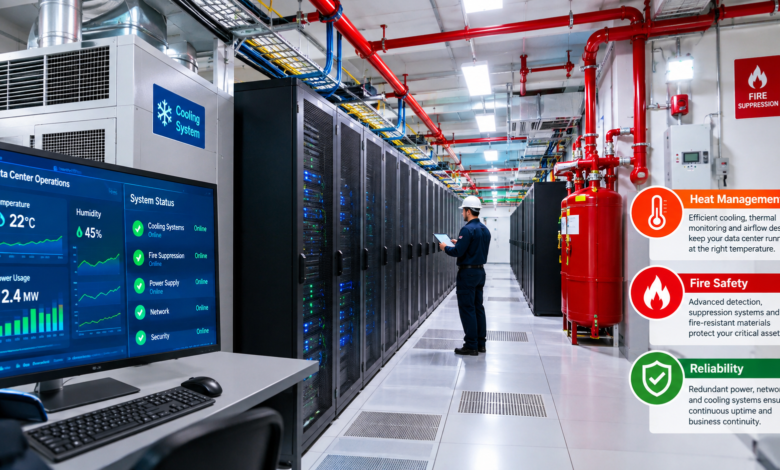
Introduction
Modern data centers are expected to operate continuously while supporting increasingly powerful servers, cloud platforms, artificial intelligence workloads, and business-critical applications. As computing density increases, facility designers must think beyond server capacity. Temperature control, fire protection, electrical resilience, airflow, monitoring, and operational reliability all need to work together.
Data Center Design Priorities for Heat, Fire Safety, and Reliability provide a useful framework for planning facilities that can manage demanding workloads without unnecessarily increasing operational risks. Good design considers both everyday efficiency and unexpected events, helping protect equipment, information, employees, and business continuity.
Why Data Center Design Requires a Multi-Layered Approach
A data center is a connected system rather than simply a room filled with servers. IT equipment produces heat, cooling systems remove that heat, electrical infrastructure supplies power, and fire protection systems help reduce the consequences of an emergency.
A weakness in one area can affect another. For example, inefficient airflow can increase cooling requirements, while an inadequate power design can interrupt cooling and create additional thermal stress. The U.S. Department of Energy identifies IT efficiency, environmental conditions, air management, cooling, electrical systems, and heat recovery as important elements of energy-efficient data center design.
This means facility planning should begin with a complete understanding of expected workloads, equipment densities, environmental conditions, future expansion, and required availability.
Heat Management Should Be a Primary Design Priority
Control Temperature and Humidity
Servers and other IT equipment generate substantial heat during operation. If heat is not removed effectively, equipment can experience thermal stress, reduced performance, or unexpected shutdowns.
ASHRAE recommends designing data center environments around appropriate equipment inlet temperature and humidity conditions. Its current thermal guidance also recognizes that high-density equipment may require additional cooling considerations.
Rather than simply making a room colder, designers should focus on maintaining stable conditions where equipment actually receives air. Temperature sensors should therefore be positioned strategically throughout the facility instead of relying on a single room-level measurement.
Humidity also deserves careful attention. Excessive moisture can contribute to corrosion, while appropriate moisture control can support equipment reliability and efficient operation. ASHRAE recommends monitoring moisture conditions carefully, including the use of dew point as an important measurement.
Improve Airflow Management
Airflow management can significantly influence cooling performance. Hot exhaust air should not be allowed to mix unnecessarily with the cool air supplied to server equipment.
Common design approaches include organized rack layouts, hot-aisle and cold-aisle arrangements, containment systems, appropriate floor grilles, and carefully planned supply and return-air paths.
ASHRAE identifies equipment placement and airflow patterns as important areas for achieving data center reliability and energy efficiency.
Good airflow management can allow cooling systems to operate more efficiently while reducing localized hot spots.
Plan Cooling for High-Density Computing
Prepare for Changing Workloads
Traditional server environments and modern high-density computing can have very different thermal requirements. Artificial intelligence and high-performance computing workloads can place substantially greater demands on cooling infrastructure.
ASHRAE’s current AI data center guidance highlights cooling architectures aligned with rack densities, air management, containment, raised temperature setpoints, and liquid cooling where appropriate for high-density applications.
For this reason, cooling capacity should not be based only on today’s equipment. Designers should consider future rack densities and potential technology changes.
Consider Cooling Redundancy
A cooling system should not depend on one component if downtime would create serious consequences. Depending on the facility’s requirements, designers may provide redundant chillers, pumps, computer room cooling units, cooling loops, or other supporting infrastructure.
The appropriate level of redundancy depends on the business requirement, budget, equipment configuration, and desired availability.
Fire Safety Must Be Built Into the Design
Fire safety is another fundamental part of data center planning. Electrical equipment, batteries, cables, power distribution systems, and other infrastructure can introduce potential fire risks.
A comprehensive fire strategy should include appropriate detection, alarm systems, suppression technology, compartmentation, emergency procedures, and regular inspection.
The objective is not simply to install extinguishing equipment. A well-designed fire protection strategy should detect problems early, limit the spread of an incident, protect critical areas, and support safe emergency response.
Designers should follow applicable building codes, fire codes, and recognized standards for the facility’s location and use. Qualified fire protection professionals should be involved in determining the appropriate system for the specific building.
Protect Power Infrastructure and Reliability
Use Appropriate Electrical Resilience
Reliable computing depends on reliable electricity. Power interruptions can stop servers, cooling systems, networking equipment, security systems, and monitoring infrastructure.
Depending on availability requirements, a data center may use UPS systems, backup generators, redundant distribution paths, and multiple power sources.
Uptime Institute’s tier framework illustrates how different infrastructure configurations provide different levels of redundancy and maintenance capability.
The correct design should be based on the consequences of downtime rather than simply choosing the most complex system available.
Separate Critical Systems Where Practical
Electrical and mechanical infrastructure should be organized so that a single failure does not unnecessarily affect the entire facility.
Designers can consider separate distribution paths, redundant components, maintenance bypass arrangements, and carefully coordinated protection systems. Testing these arrangements is equally important because redundancy only provides value when systems actually operate as intended.
Monitoring Is Essential for Modern Data Centers
A reliable facility needs continuous visibility. Monitoring systems can track temperature, humidity, power consumption, cooling performance, equipment status, alarms, and other operating conditions.
Sensors can help identify developing problems before they become major incidents. For example, a gradual temperature increase in one server row may indicate an airflow problem, cooling failure, blocked supply path, or changing equipment load.
Automated alerts can help operators respond more quickly, while historical data can support maintenance and capacity planning.
Design for Maintenance and Future Expansion
Data center infrastructure must be maintainable. Equipment eventually needs inspection, repair, replacement, or upgrades.
Maintenance areas, equipment access, service clearances, cable pathways, and isolation procedures should therefore be considered during the initial design.
Future expansion is also important. A facility designed with no room for additional power, cooling, network capacity, or physical equipment may become difficult and expensive to upgrade.
Modular approaches can help organizations expand infrastructure as demand increases without redesigning the entire facility.
Energy Efficiency Should Support Reliability
Energy efficiency is important, but it should not come at the expense of safe operating conditions. The best approach is to improve efficiency while maintaining appropriate environmental conditions and resilience.
The Department of Energy’s data center guidance emphasizes air management, cooling and electrical systems, environmental conditions, and heat recovery as connected areas for improving efficiency.
Efficient airflow, properly selected cooling equipment, optimized controls, appropriate temperature settings, and effective monitoring can all contribute to lower energy consumption.
A Practical Data Center Design Checklist
Before finalizing a data center design, organizations should consider:
- Expected IT load and future workload growth
- Rack density and heat generation
- Temperature and humidity monitoring
- Airflow paths and containment
- Cooling capacity and redundancy
- High-density or liquid-cooling requirements
- Fire detection and suppression
- Electrical distribution and backup power
- UPS and generator requirements
- Physical and operational security
- Environmental monitoring
- Preventive maintenance access
- Emergency procedures
- Expansion capacity
- Applicable local building and fire requirements
Conclusion
Data Center Design Priorities for Heat, Fire Safety, and Reliability should be considered together rather than as separate engineering tasks. Effective heat management protects IT equipment, strong fire protection reduces emergency risks, and resilient electrical and cooling infrastructure helps maintain continuity.
The strongest designs also include intelligent monitoring, organized airflow, appropriate redundancy, maintainability, and room for future growth. As computing densities continue to rise, particularly with advanced AI and high-performance workloads, data center design will need to become increasingly adaptable.
A successful facility is not simply one that houses powerful servers. It is an environment engineered to keep those systems operating safely, efficiently, and reliably over the long term.


