Freddie Ljungberg: From Arsenal’s Invincibles to His Life After Football
From His Famous Arsenal Years to International Football, Family Life and Coaching Career

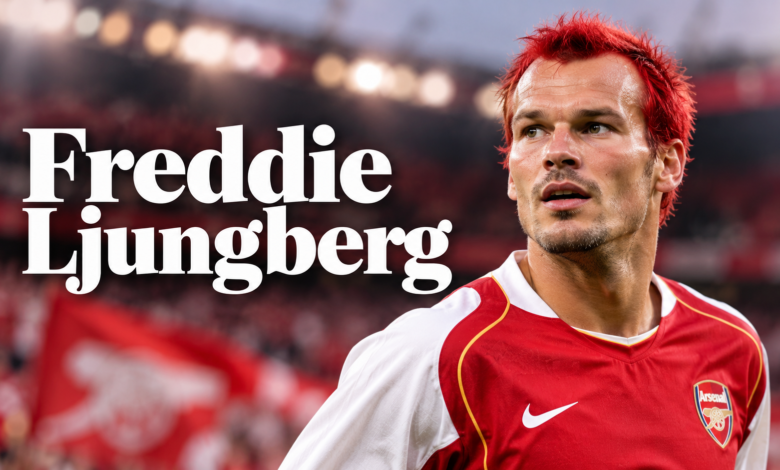
Introduction
The story of a Swedish football star who won major trophies, became an Arsenal favourite and later returned to the club as a coach.
Freddie Ljungberg is a former Swedish footballer and coach, best known for his time at Arsenal. He played a major part in the club’s success under Arsène Wenger, winning two Premier League titles and three FA Cups.
His football journey started in Sweden.
Born on 16 April 1977, he began playing at Halmstads BK before moving to Arsenal in 1998. Fans soon recognised him for his sharp attacking runs, important goals and famous red hairstyles.
His biggest years came in London.
He helped Arsenal win the 2001–02 Premier League and FA Cup Double. Two years later, he belonged to the unbeaten team known as the Invincibles.
After retiring from professional football, he moved into coaching. He even became Arsenal’s interim head coach in 2019.
Here is his full story.
Quick Facts About His Life
| Detail | Information |
|---|---|
| Full Name | Karl Fredrik Ljungberg |
| Popular Name | Freddie Ljungberg |
| Date of Birth | 16 April 1977 |
| Age | 49 years (October 2026) |
| Birthplace | Vittsjö, Sweden |
| Nationality | Swedish |
| Height | 175 cm |
| Profession | Former footballer and coach |
| Playing Position | Winger, midfielder |
| First Senior Club | Halmstads BK |
| Famous Club | Arsenal FC |
| Arsenal Career | 1998–2007 |
| Premier League Titles | 2 |
| FA Cup Titles | 3 |
| Sweden Appearances | 75 |
| International Goals | 14 |
| World Cup Appearances | 2002 and 2006 |
| Wife | Natalie Foster |
| Children | Two, according to published reports |
| Former Coaching Role | Arsenal interim head coach |
| Net Worth | Not independently verified |
Early Life and Childhood
Freddie Ljungberg was born in Vittsjö, Sweden, on 16 April 1977.
His family moved to Halmstad when he was a young child. That move became an important part of his football story.
He joined Halmstads BK’s youth system at around five years old.
Football was not his only interest.
As a youngster, he also played sports such as handball and ice hockey. These activities gave him experience with different styles of movement and team competition.
But football became his main focus.
He spent years learning the game, moving through youth teams and preparing for professional competition.
His progress eventually earned him a place in the senior squad.
Starting His Football Career in Sweden
His senior career began in 1994.
At Halmstads BK, he developed into an attacking player who could operate in midfield or on the wing.
He was quick. Very quick.
But speed alone did not define his game. He understood how to move into empty spaces and find opportunities near the opposition’s goal.
His early performances helped Halmstad compete successfully in Swedish football.
The club won the Swedish Cup in 1995.
Then came another major achievement.
Halmstad won the Swedish league championship in 1997.
That success attracted attention beyond Sweden. Arsenal eventually made the move to sign him.
Joining Arsenal and Moving to England
In September 1998, Ljungberg joined Arsenal.
Arsène Wenger was building a strong team in north London, and the Swedish midfielder became part of that project.
His first Premier League appearance was memorable.
He scored against Manchester United during Arsenal’s 3–0 victory on 20 September 1998.
What a way to start.
Scoring against one of England’s strongest clubs gave supporters an early look at his attacking ability.
His first season was about learning.
English football demanded speed, physical strength and quick decisions. He needed to adjust to new teammates and a different playing style.
Over time, he became a regular member of Wenger’s squad.
Becoming an Important Arsenal Player
Ljungberg’s Arsenal career lasted nine seasons, from 1998 to 2007.
During that period, he played alongside Thierry Henry, Dennis Bergkamp, Patrick Vieira, Robert Pirès and several other established stars.
He had a particular skill.
He could appear in dangerous attacking positions without defenders expecting him.
Rather than staying wide throughout a match, he moved inside and made runs towards goal.
His timing helped Arsenal create chances.
Wenger’s attacking system suited him well. Players could exchange positions, pass quickly and look for openings behind defenders.
Ljungberg became especially useful during fast attacks.
He also worked hard defensively and regularly tracked back to help his teammates.
The fans noticed his effort.
His red hair, energetic performances and important goals made him one of Arsenal’s recognisable players.
Winning the Premier League and FA Cup Double
The 2001–02 season changed his career.
Arsenal won the Premier League title after a strong campaign under Wenger.
The team finished ahead of Liverpool and Manchester United.
But the league was only part of the story.
Arsenal also reached the FA Cup final against Chelsea at Cardiff’s Millennium Stadium.
Ray Parlour opened the scoring.
Then Ljungberg scored Arsenal’s second goal, helping secure a 2–0 victory.
The club had completed the Double.
His performances throughout the season brought individual recognition too.
He won the Premier League Player of the Season award for 2001–02.
That was a major honour.
He had become one of the league’s standout performers while helping Arsenal win two major trophies.
The Famous Invincibles Season
The 2003–04 season is still remembered by Arsenal supporters.
The club played 38 Premier League matches without losing.
Arsenal won 26 games and drew 12.
No defeats.
The squad became known as the Invincibles.
Ljungberg was part of a team filled with experienced international players.
Thierry Henry scored regularly. Patrick Vieira led from midfield. Dennis Bergkamp created chances with his passing and movement.
Ljungberg contributed his own attacking skills.
He made runs, found space and helped the team maintain pressure on opponents.
Arsenal finished the season as Premier League champions.
For Ljungberg, it was his second English league title.
That unbeaten campaign remains one of the best-known achievements in the Premier League’s history.
His FA Cup Success
Ljungberg won three FA Cups with Arsenal.
Those victories came in 2002, 2003 and 2005.
His 2002 final goal against Chelsea remains one of his famous moments.
He also scored against Liverpool in the 2001 FA Cup final, although Arsenal lost that match 2–1.
Scoring in major finals showed his ability to contribute during important games.
He was not Arsenal’s main striker.
Yet his movement from midfield often put him in positions where he could finish attacks.
That made him valuable during cup competitions as well as league matches.
His Premier League Statistics
The Premier League’s current player database lists the following career numbers for Ljungberg.
| Statistic | Total |
|---|---|
| Premier League Appearances | 241 |
| Goals | 48 |
| Assists | 29 |
| Premier League Titles | 2 |
| Player of the Season Awards | 1 |
These figures come from the Premier League’s published player record. Historical appearance totals in some other databases differ, so the numbers above should be understood as the league website’s current listing.
His achievements matter beyond the statistics.
He became known for making important contributions during successful Arsenal seasons, especially when the club needed attacking movement from midfield.
Representing Sweden at International Level
Ljungberg represented Sweden’s senior national team between 1998 and 2008.
He played 75 international matches and scored 14 goals.
His first senior international appearance came against the United States in January 1998.
He later represented Sweden in two World Cups and three European Championships.
| Tournament | Year |
|---|---|
| UEFA European Championship | 2000 |
| FIFA World Cup | 2002 |
| UEFA European Championship | 2004 |
| FIFA World Cup | 2006 |
| UEFA European Championship | 2008 |
These tournaments gave him experience against leading international teams.
One memorable moment came at the 2006 World Cup.
Sweden faced Paraguay in the group stage. The match remained goalless until Ljungberg scored a late header.
Sweden won 1–0.
He later captained the national side and retired from international football after Euro 2008.
Leaving Arsenal in 2007
Ljungberg left Arsenal in 2007.
He joined West Ham United, staying in the Premier League.
The move followed nine years at Arsenal and several major trophies.
His time at West Ham lasted one season.
After leaving English football, he continued playing abroad.
His next destination was the United States.
Playing in Major League Soccer
In 2009, Ljungberg joined Seattle Sounders FC.
He became part of the club’s early years in Major League Soccer.
His experience and technical ability made him a recognised player in the league.
Seattle won the US Open Cup in 2009.
He later moved to Chicago Fire in 2010.
Playing in America added a new chapter to his career.
He had already won major trophies in England and Sweden. MLS gave him the chance to compete in another football environment.
Football Career in Scotland, Japan and India
Ljungberg’s playing career continued across several countries.
In 2011, he joined Celtic in Scotland.
He was part of the club during its Scottish Cup-winning 2010–11 season.
Later that year, he joined Japanese club Shimizu S-Pulse.
He played in Japan until 2012.
There was still one more professional spell.
In 2014, he joined Mumbai City FC in the Indian Super League.
His appearance in India marked the final stage of his professional playing career.
Complete Senior Club History
| Club | Years |
|---|---|
| Halmstads BK | 1994–1998 |
| Arsenal | 1998–2007 |
| West Ham United | 2007–2008 |
| Seattle Sounders | 2009–2010 |
| Chicago Fire | 2010 |
| Celtic | 2011 |
| Shimizu S-Pulse | 2011–2012 |
| Mumbai City | 2014 |
He competed in several football systems, but Arsenal remained the club most closely associated with his success.
Retirement and Life After Playing
After his final professional playing spell, Ljungberg focused on new opportunities.
He had spent around two decades competing at senior level.
Coaching became his next career.
His playing experience gave him knowledge of tactics, dressing-room expectations and the demands of professional football.
He began working with young players at Arsenal.
This brought him back to the club where he had enjoyed his biggest achievements.
Beginning His Coaching Career
Ljungberg worked within Arsenal’s youth setup before moving to Germany.
In 2017, he joined VfL Wolfsburg as an assistant coach.
The role gave him experience in the German Bundesliga.
He then returned to Arsenal in 2018.
This time, he became head coach of the club’s under-23 team.
His responsibilities involved developing young players and preparing them for senior football.
In 2019, Arsenal moved him into the first-team coaching staff.
He worked alongside the senior coaching team during a difficult period for the club.
Becoming Arsenal’s Interim Head Coach
In November 2019, Arsenal dismissed manager Unai Emery.
The club appointed Ljungberg as interim head coach.
It was an important moment.
He had played for Arsenal, coached young players and now had responsibility for the senior team.
His first match in charge was a 2–2 draw against Norwich City.
He later recorded his first victory with a 3–1 win over West Ham United.
The position was temporary.
In December 2019, Arsenal appointed Mikel Arteta as head coach.
Ljungberg continued working with the coaching staff after Arteta arrived.
He left Arsenal in August 2020 to pursue other opportunities.
His Work with Young Footballers
One part of Ljungberg’s coaching career involved helping young Arsenal players.
He worked within the academy during a period when several talented youngsters were progressing towards first-team football.
His experience helped him understand the pressure young players face.
Football requires more than talent.
Players need to read situations, make quick decisions and handle difficult moments during matches.
As a former top-level midfielder, Ljungberg could share direct experience from his own career.
His work within Arsenal’s youth system became another important part of his relationship with the club.
What Is He Doing in 2026?
Ljungberg has remained connected with football since leaving Arsenal’s coaching staff.
In 2025, he took part in Baller League UK.
He joined former Arsenal teammates Jens Lehmann and Robert Pirès in managing N5 FC.
The competition uses a six-a-side format and features former professional players, football personalities and other participants.
The N5 FC name referred to Arsenal’s north London connections.
As of 10 October 2026, a new permanent appointment as manager of a major professional club could not be reliably confirmed.
His 2025 Baller League role is documented, but it should not be described as an active 2026 coaching position without newer confirmation.
Wife and Married Life
Freddie Ljungberg married Natalie Foster on 7 June 2014.
Their wedding took place at the Natural History Museum in London.
The ceremony attracted media attention because of his football career and public profile.
Natalie Foster is the daughter of businessman Daryl Foster, who was associated with London transport company Addison Lee.
Published reporting states that the couple met in 2007.
Their wedding was attended by guests from football and other professional circles.
Ljungberg has generally kept his personal life away from regular media coverage.
Children and Family
Published biographical accounts report that Ljungberg and Natalie Foster have two children.
He has spoken publicly about family life on limited occasions, but most available interviews focus on football.
The couple have largely kept their children’s private lives separate from his career.
For that reason, details about their children’s personal activities and education are not included here.
Modelling and Fashion Career
Football was not his only public activity.
Ljungberg also became known for modelling.
During the early 2000s, he appeared in advertising campaigns for Calvin Klein.
The campaigns attracted considerable attention.
His distinctive look helped make him recognisable outside football stadiums.
He often changed his hairstyle during his Arsenal years, including periods when he dyed his hair bright red.
His appearance in major advertising campaigns gave him a different kind of public profile.
Still, his football achievements remained the main reason for his fame.
Playing Style and Strengths
Ljungberg was a midfielder who could operate on either wing.
His greatest strength was movement.
He regularly ran into areas that defenders struggled to cover.
That movement helped Arsenal create scoring opportunities.
He was also known for his stamina and willingness to help defensively.
He could press opponents, support teammates and move forward quickly after Arsenal regained possession.
His finishing ability was useful too.
Although he was not a traditional centre-forward, he scored several important goals during his career.
His 2002 FA Cup final goal is a good example.
He understood when to make a run and how to finish after reaching a dangerous position.
Major Football Trophies and Awards
| Honour | Club or Award | Year |
|---|---|---|
| Swedish Cup | Halmstads BK | 1995 |
| Swedish League | Halmstads BK | 1997 |
| Premier League | Arsenal | 2001–02 |
| Premier League | Arsenal | 2003–04 |
| FA Cup | Arsenal | 2002 |
| FA Cup | Arsenal | 2003 |
| FA Cup | Arsenal | 2005 |
| Premier League Player of the Season | Individual | 2001–02 |
| Swedish Footballer of the Year | Individual | 2002 |
| Swedish Footballer of the Year | Individual | 2006 |
| US Open Cup | Seattle Sounders | 2009 |
| Scottish Cup | Celtic | 2011 |
His Premier League titles, three FA Cups and Player of the Season award remain central achievements of his playing career.
Net Worth and Career Earnings
Ljungberg earned money through professional football contracts, coaching work and commercial partnerships.
He played for clubs in several countries and appeared in international advertising campaigns.
However, his personal net worth in 2026 has not been independently verified.
Public estimates found on celebrity websites often lack reliable supporting financial records.
It is better to leave the amount unconfirmed than publish a figure that cannot be checked.
His Place in Arsenal History
Arsenal supporters remember Ljungberg for several reasons.
He scored important goals and contributed to major trophy wins.
He was part of the Invincibles.
His unusual hairstyles made him easy to recognise, but his performances mattered far more.
He also returned to Arsenal as a coach.
That continued his association with the club beyond his playing career.
For many supporters, his strongest years represent a period when Arsenal regularly competed for England’s biggest domestic trophies.
Final Thought
Freddie Ljungberg built his football career through years of hard work.
He started at Halmstads BK, moved to Arsenal and became part of one of the club’s most successful teams.
His goals helped win trophies. His movement made him an effective midfielder.
Then came the Invincibles.
After retiring, he returned to football as a coach and briefly managed Arsenal’s first team.
His career has taken him across several countries, but his years in north London remain the part most football fans remember.
The trophies tell one story.
His long connection with Arsenal tells another.
Frequently Asked Questions
1. Who is Freddie Ljungberg?
Freddie Ljungberg is a former Swedish footballer and coach. He is best known for winning two Premier League titles and three FA Cups with Arsenal.
2. How old is Freddie Ljungberg?
He was born on 16 April 1977. He is 49 years old as of October 2026.
3. Where was Freddie Ljungberg born?
He was born in Vittsjö, Sweden. His family later moved to Halmstad.
4. Is Freddie Ljungberg married?
Yes. He married Natalie Foster on 7 June 2014 at London’s Natural History Museum.
5. Does Freddie Ljungberg have children?
Published biographical information states that he has two children.
6. Was Freddie Ljungberg part of Arsenal’s Invincibles?
Yes. He played for Arsenal during the unbeaten 2003–04 Premier League season.
7. How many goals did he score for Sweden?
He scored 14 goals in 75 senior international appearances.
8. Is Freddie Ljungberg still Arsenal’s manager?
No. He served as interim head coach in 2019 and left Arsenal’s coaching staff in August 2020.