The Future of Music Education: Smarter Learning for Everyone
How Technology, AI, and Human Creativity Are Transforming Music Learning

Introduction
Music education is changing as technology becomes a bigger part of how students learn, practice, create, and share music. Traditional lessons built around instruments, sheet music, rehearsals, and face-to-face instruction remain important, but they are increasingly being supported by digital tools, online resources, music software, interactive learning platforms, and artificial intelligence.
The future of music education is therefore unlikely to be about replacing traditional teaching with technology. Instead, it is likely to combine the strengths of human instruction with tools that can provide additional practice, feedback, creative possibilities, and access to learning resources. Recent research and professional guidance show growing interest in AI-assisted music education, while also highlighting concerns about ethics, accessibility, teacher preparation, and responsible use.
How Technology Is Changing Music Education
Technology has already expanded what can happen inside and outside the music classroom. Students can use digital audio workstations, notation software, MIDI controllers, recording applications, interactive tutorials, and online educational materials to explore music in different ways.
Instead of learning only through a textbook or a teacher demonstration, students can experiment with sounds, record their performances, edit compositions, and listen to their progress. This can make music education more interactive and give learners more opportunities to practice independently.
Digital technology also supports different learning styles. A student who struggles to understand a concept through written notation may benefit from listening examples, visual demonstrations, interactive exercises, or recorded performances.
The Growing Role of Artificial Intelligence
Artificial intelligence is becoming one of the most discussed developments in music education. Professional music-education organizations are already examining how AI can support creativity, performance, reflection, assessment, and teacher productivity.
AI-powered systems can potentially provide personalized exercises, generate practice ideas, analyze aspects of musical performance, and help educators develop learning materials. Research published in 2026 also reports that AI and digital tools are being studied for areas such as sight-singing and aural training, with adaptive systems showing potential for improving pitch perception, rhythmic accuracy, and melodic dictation when integrated appropriately into teaching.
However, AI should not be treated as an automatic replacement for a music teacher. Music involves interpretation, emotion, cultural understanding, collaboration, and personal expression. These areas require human judgment and meaningful relationships between teachers and learners.
Personalized Music Learning
One of the most promising possibilities for the future of music education is personalized learning.
Students do not all learn at the same speed. One learner may need additional practice with rhythm, while another may want to concentrate on harmony, improvisation, songwriting, or performance technique.
Digital platforms can make it easier to provide different exercises for different learners. AI-assisted systems may also help identify areas where students need additional practice and recommend activities based on their progress.
Research involving music students has found relationships between positive perceptions of AI-based learning tools, motivation, engagement, creativity, and learning success. These findings suggest that well-designed technology can make learning more interactive, although research is still developing and should not be treated as proof that technology alone improves every student’s results.
Online Music Education and Global Access
The internet has also changed where music education can take place. Students can access lessons, tutorials, performances, theory resources, practice materials, and educational communities from locations far beyond their local schools or music studios.
This can be particularly valuable for learners who have limited access to specialized teachers or instruments.
Digital learning is also becoming increasingly important in countries where access to quality educational resources can vary. UNESCO has highlighted both the opportunities created by digital learning and the continuing need for trusted platforms, digital literacy, and responsible use of emerging technologies.
However, online access does not automatically create equal opportunity. Reliable internet connections, suitable devices, software, instruments, and teacher support can still be unavailable to some learners. Addressing this digital divide will be an important part of the future of music education.
Music Creation Will Become More Accessible
Technology is making music creation available to more people. Students no longer need access to a professional recording studio to experiment with composition and production.
A computer or mobile device can provide access to virtual instruments, recording tools, digital effects, loops, notation systems, and production environments. Students can experiment with different musical styles and develop projects that combine performance with technology.
Generative AI may expand these possibilities further by becoming a creative collaborator in certain learning situations. Academic research has explored how generative AI can participate in creative collaboration while also questioning its limitations, particularly around ethical judgment and educational responsibility.
This means students may increasingly learn not only how to perform music but also how to produce, arrange, record, edit, and critically evaluate it.
The Teacher Will Remain Essential
Despite rapid technological development, teachers will continue to have an important role in music education.
A teacher can recognize when a student is frustrated, encourage confidence, demonstrate musical expression, organize ensembles, explain difficult concepts, and help students understand the cultural and emotional dimensions of music.
UNESCO has emphasized that teachers bring human connection, critical thinking, ethical reasoning, emotional intelligence, and social belonging to education—qualities that technology cannot simply reproduce.
The future teacher may therefore work alongside technology rather than compete with it. Instead of spending all their time on repetitive tasks, educators may use digital tools to support lesson preparation, assessment, practice activities, and individualized instruction while spending more time on meaningful human interaction.
New Approaches to Assessment
Assessment is another area likely to change.
Traditional music assessment may involve performances, written theory examinations, compositions, and teacher observations. Digital tools can add new forms of evidence, such as recorded progress, digital portfolios, practice data, and interactive assignments.
AI may eventually help teachers analyze certain aspects of performance or provide preliminary feedback. Research on AI and assessment in music education notes both opportunities for differentiation and challenges involving grading, ethics, and responsible use.
Human teachers will still need to interpret results carefully. A technical score cannot fully measure musical expression, originality, emotional communication, or artistic development.
Creativity and Critical Thinking Must Stay Central
The availability of powerful technology creates an important educational question: Are students creating music themselves, or are they simply allowing software to create it for them?
Future music education will need to place strong emphasis on creativity and critical thinking. Students should understand how digital tools work and learn to question their results.
For example, an AI-generated musical idea can become a starting point for discussion. Students can analyze it, change it, reject it, combine it with their own ideas, or explain why a particular musical choice works.
Research and professional guidance increasingly emphasize ethical, student-centered approaches to AI in education, including questions surrounding bias, privacy, creativity, and responsible use.
The Importance of Teacher Training
Technology is only useful when educators know how to use it effectively.
Music teachers will increasingly need professional development in areas such as digital audio, music production, educational software, online instruction, AI literacy, digital citizenship, and data privacy.
A 2025 study of pre-service music teachers found strong technology-integration self-efficacy but also identified differences across areas of AI literacy, reinforcing the need for teacher education programs to develop practical and ethical technology skills.
Teacher training should therefore focus on more than learning which buttons to press. Educators need to understand when technology improves learning, when traditional methods are more appropriate, and how to help students use AI responsibly.
What the Future Music Classroom May Look Like
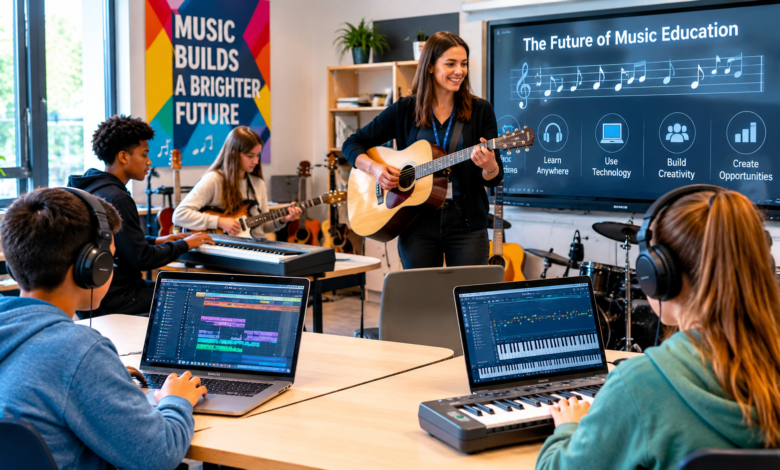
The music classroom of the future could combine traditional instruments with digital workstations, interactive displays, recording equipment, headphones, virtual instruments, and collaborative online platforms.
A typical lesson might begin with a teacher explaining a musical concept. Students could then practice using instruments, complete interactive exercises, record their performances, receive digital feedback, and collaborate on a composition.
Technology could provide additional practice outside school, while the classroom remains a place for ensemble playing, discussion, creativity, performance, and personal guidance.
This blended approach could make music education more flexible without removing the human character that makes music learning meaningful.
Challenges Facing the Future of Music Education
The future also brings challenges.
The first is access. Not every school or student has the same technology, internet connectivity, instruments, or software.
The second is teacher preparation. Educators need sufficient training and time to adopt new tools responsibly.
The third is privacy and ethics. AI systems may involve student data, and schools must consider how information is collected, stored, and used.
The fourth is authenticity. Students need to understand the difference between using technology as a creative tool and allowing technology to complete the learning process for them.
Research on music education and AI continues to identify accessibility, teacher training, algorithmic transparency, and gaps in long-term evidence as important issues.
A Balanced Future for Music Education
The most useful vision of music education is not one where technology replaces everything that came before it. Instead, the future can combine proven teaching practices with carefully selected digital tools.
Students can continue learning instruments, singing, reading music, performing in groups, and studying musical history while also developing skills in recording, composition, digital production, and responsible AI use.
This combination can prepare learners for a world in which musical creativity increasingly crosses traditional boundaries.
Conclusion
The future of music education will be shaped by technology, but technology alone will not define it. Artificial intelligence, digital learning platforms, music-production software, interactive tools, and online resources can expand the ways students practice and create.
At the same time, teachers, creativity, collaboration, critical thinking, and human expression will remain central. Current research suggests that AI and digital technologies can support personalized and interactive learning, but important questions about access, ethics, teacher training, privacy, and long-term educational impact remain.
Ultimately, the future of music education is likely to be a partnership between human creativity and responsible technology. When digital innovation is used thoughtfully, it can give more learners opportunities to explore music, develop their skills, and discover their own creative voices


